Disputed vehicle valuations create frustration for drivers and unnecessary work for claims teams. Our AI-powered pre-accident valuation assistant helps customers understand the evidence behind their vehicle's assessed value, while reducing the administrative burden on insurers and accident management companies.
Anyone involved in motor claims will be familiar with the frustration surrounding disputed pre-accident valuations. An engineer assesses a vehicle's value, the driver disagrees, and what should be a relatively straightforward stage of the claims process can become a lengthy exchange of telephone calls, emails and requests for reconsideration.
The difficulty is often less about the accuracy of the valuation and more about the customer's understanding of how that figure was reached, not to mention historic pub-stories of greedy insurers lowballing their insured & the days when it was an 'offer' not a valuation!
At Laird, we've been helping clients address these challenges through our AI-powered valuation assistant, a service worth highlighting as insurers and accident management companies continue to look for ways to improve customer experience while reducing claims-handling costs.
Why vehicle valuations are so frequently challenged
For most people, their vehicle represents a significant financial commitment. Unfortunately, the amount they paid for it, the finance they still owe and its current market value can be three very different figures.
Depreciation is particularly difficult to accept when a vehicle has been written off unexpectedly. A driver who purchased a car for £35,000 two years ago may be understandably disappointed to discover that its current market value is considerably lower. Where outstanding finance exceeds that valuation, the frustration can be greater still.
This creates an understandable tension. The customer wants sufficient compensation to replace their vehicle, while the engineer has a professional responsibility to establish an accurate and defensible pre-accident value.
Our approach has always been to assess each vehicle on its individual merits, considering factors including age, mileage, specification, condition and relevant market evidence.
The objective is not to identify the cheapest comparable vehicle advertised for sale. It is to establish a fair, reasonable and supportable market value that gives the customer a realistic opportunity to purchase an equivalent replacement.
That distinction matters, both to the customer and to the integrity of the claims process.
Bringing the market evidence directly to the customer
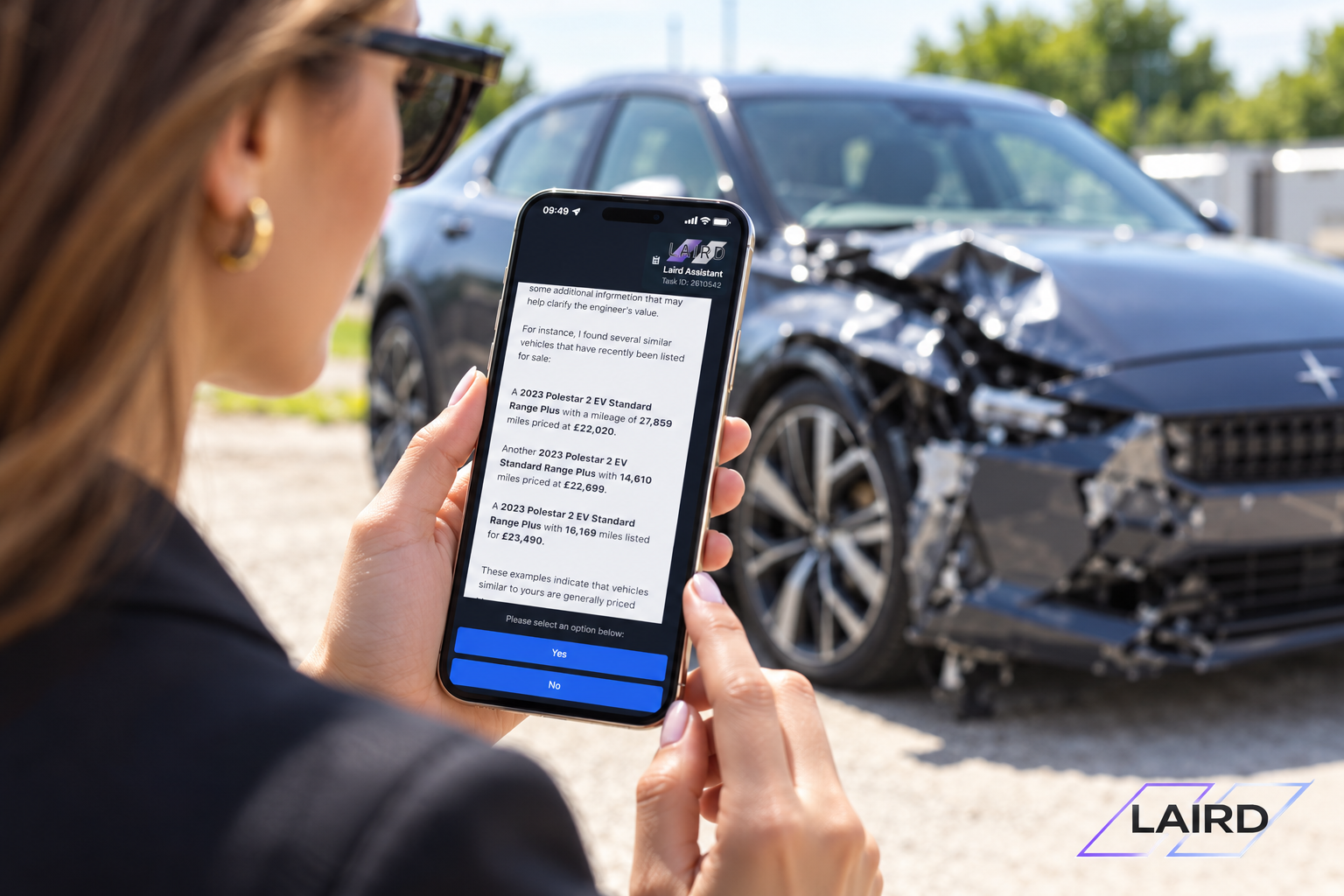
One of the services available to Laird's clients is our interactive AI valuation assistant, designed to help resolve valuation disputes by making the supporting market evidence more accessible.
When a customer questions the engineer's assessed pre-accident value, our client can send them a link to the assistant, accessible directly from their smartphone.
Rather than waiting for another telephone conversation with a claims handler, the customer can engage with the assistant at a convenient time and review relevant information about their valuation.
The assistant presents examples of comparable vehicles currently advertised for sale, including their specifications, mileage and asking prices. This allows the customer to see how the engineer's assessment relates to the wider market and, importantly, what similar replacement vehicles are actually available to purchase.
For example, a driver disputing the valuation of a 2023 Polestar 2 might be shown several comparable vehicles advertised at prices around the engineer's assessment. Seeing real-world examples can provide considerably more reassurance than simply being told that a valuation has been calculated correctly.
There is also an important distinction between advertised prices and achieved selling prices. Advertisements provide useful market evidence, but they must be interpreted appropriately, taking account of specification, condition, mileage and other relevant differences.
The assistant supports the engineer's professional assessment, rather than attempting to replace it.
Better communication, fewer unnecessary disputes
One of the recurring challenges in motor claims is that customers often receive a valuation figure without having access to the supporting market context.
The engineer may have undertaken a perfectly reasonable assessment, but the customer sees only the financial outcome.
By making relevant comparable vehicles visible and explaining the rationale in accessible language, we can help bridge that information gap.
Naturally, some customers will still have legitimate grounds to question a valuation. Their vehicle may have unusual specifications, exceptionally low mileage or other characteristics that warrant further consideration.
Those concerns should continue to receive appropriate professional attention. Indeed, one of the advantages of an automated first stage is that it allows engineering and claims teams to concentrate on disputes where additional judgement or investigation is genuinely required.
The intention is to improve the quality of the conversation, not discourage legitimate challenges.
A commercial benefit for insurers and accident management companies
For claims operations handling significant volumes of total losses, the cumulative cost of valuation disputes can be substantial.
A relatively small proportion of customers making repeated calls, requesting explanations or negotiating for higher settlements can consume considerable claims-handling capacity.
Much of that activity involves explaining information that already exists, rather than undertaking any new engineering assessment.
Our valuation assistant provides an opportunity to automate much of this initial communication, making relevant evidence available directly to the customer without requiring a claims handler to retrieve and explain it individually.
The potential operational benefits include reduced inbound call volumes, shorter dispute-resolution times, more consistent explanations and improved customer satisfaction.
There is also an important management consideration. Claims handlers should be spending their time exercising judgement, resolving genuine exceptions and progressing claims, rather than repeatedly explaining depreciation and market values.
For larger operations, even modest reductions in average handling time can produce meaningful efficiency improvements.
Available as a white-labelled solution
Recognising that the customer relationship belongs to our clients, the assistant is also available as a white-labelled service.
This allows insurers, accident management companies and other claims organisations to present the technology within their own customer experience, maintaining brand continuity while benefiting from Laird's engineering expertise and valuation processes (you may have already seen or used it but not know it's ours!)
It also provides a consistent approach to valuation queries across larger claims operations, particularly where multiple handlers or teams are involved.
For customers, the experience is straightforward: they receive a link, review the relevant information and can better understand the evidence supporting their vehicle's assessed value.
For claims businesses, the opportunity is to resolve more routine queries without additional manual intervention, while retaining an appropriate route for genuine disputes.
Engineering judgement remains central
There is a temptation with any AI application to focus primarily on the technology. For us, the more important consideration is whether it improves an existing process without compromising the quality of the underlying decision.
A vehicle's pre-accident value remains an engineering assessment, informed by market evidence and the individual characteristics of the vehicle. The chatbot makes that assessment more accessible, understandable and transparent.
It also acknowledges something that is occasionally overlooked in the claims process: customers need confidence that the settlement they receive will genuinely allow them to replace what they have lost.
An accurate valuation should be capable of standing up to scrutiny. Providing customers with the evidence to understand it is a sensible extension of that principle.
Making better use of the expertise we already have
Across the motor claims industry, considerable resources are devoted to managing conversations that arise from uncertainty, limited information or a lack of transparency.
Technology offers an opportunity to address some of those underlying causes, rather than simply processing the resulting enquiries more quickly.
Our valuation assistant is one example of how Laird combines independent engineering expertise with practical automation to improve both the customer experience and the economics of claims handling.
We believe the best applications of AI are those that make professional expertise more accessible, improve consistency and free experienced people to concentrate on work that genuinely requires their judgement.
For insurers and accident management companies who may not be familiar with this service, or who would like to explore how it could support their existing claims processes, we're happy to demonstrate the assistant and discuss white-labelled deployment: https://www.laird-assessors.com/contact/